Press Brake
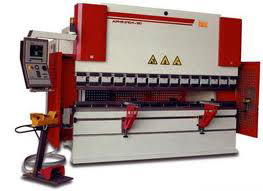
Industrial 240Tn press brake for bending sheet metal up to 20mm. Air and bottom bending with CNC control.
Description
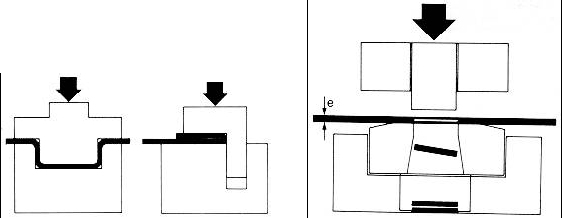
Press brakes are press-type machines used for cold-working sheet metals. Bending is the process of placing a sheet between a punch and a die and subjecting it to force, so that the sheet bends with a constant radius. With bending, we add rigidity to the part and achieve three-dimensional geometry while avoiding welding.
The thickness of the sheets to be bent usually ranges from 0.5 to 20 mm and their length from a few centimetres to several metres.
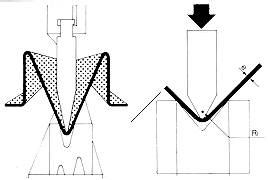
Air Bending
This bending method is characterised by the punch not taking the sheet to the bottom of the die, leaving a bending angle. It is generally used for sheets with thicknesses greater than 2 mm.
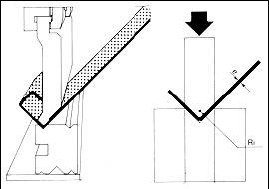
Bottom Bending
In this method, the punch takes the sheet to the bottom of the die. It is used for sheets with thicknesses less than 2 mm.
Working methodology
- Place the part resting on the rear stops, in the bending zone
- Activate the control system (pedal, bar, button)
- Hold the part, accompanying it in its elevation movement during bending
- Extract the bent part
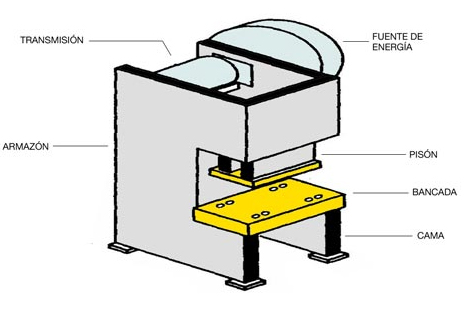
Main Elements
- The Frame: the physical structure of the machine.
- The Bed or cross plate: a casting on which the machine rests, containing the work table.
- The Ram or upper beam: generally the moving part where bending punches are housed.
- The Lower beam: a metal plate, generally fixed, on which the bending die rests.
- The Transmission: the mechanism of gears and belts that produces movement of the ram.
- The Controls: pedal, bar or push buttons for machine operation.
Accessories and Tooling
- Stroke adjustment stops
- Rear material positioning stops
- Retractable consoles and stops
- Safety devices
- Setting limiters
- Operating mode selector
Hydraulic Operation
Operation is performed in two stages:
- Approach phase: rapid closing of the ram
- Working phase: actual bending at low speed
In addition to the basic work mentioned, these machines can also be used for forming and punching operations.