Plate Rolling Machine
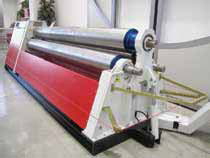
Industrial plate rolling machine for curving and rolling sheet metal. Pre-bending of 22mm and curving of 15mm.
Description
Plate rolling is a process for curving or rolling sheet metal using mechanical or hydraulic force, achieving the required radius without the need to subject the material to elevated temperatures.
Main Components
- Upper roller
- Lower roller
- Main transmission device
- Tilting device and chassis
Operation
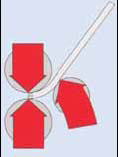
The upper roller above the two lower rollers uses hydraulic oil in the cylinder to act on the piston and perform a vertical lift. The last gear of the reducer drives the lower roller gears to rotate, which provides torsion to the plate.
Pre-bending
The curving or rolling of the sheet can be done without difficulty along almost the entire length of the sheet (or width); however, a few centimetres from the edges towards the centre of the sheet do not fully benefit from the “rolling”. This limitation is known as pre-bending.
Pre-bending is generated due to the distance between the 3 clamping rollers, and refers to the centimetres of sheet measured from the clamping point between the rollers and the support point on the side roller. This occurs at both edges of the sheet, before and after the full length has passed through and the edges come into contact with the rollers.
Applications
For decades this method has been used to achieve the curved shape of sheets that are used in the construction of countless elements, including:
- Silos
- Oil and water tanks
- Boilers
- Heat exchangers
- Other civil works equipment